
Tree services
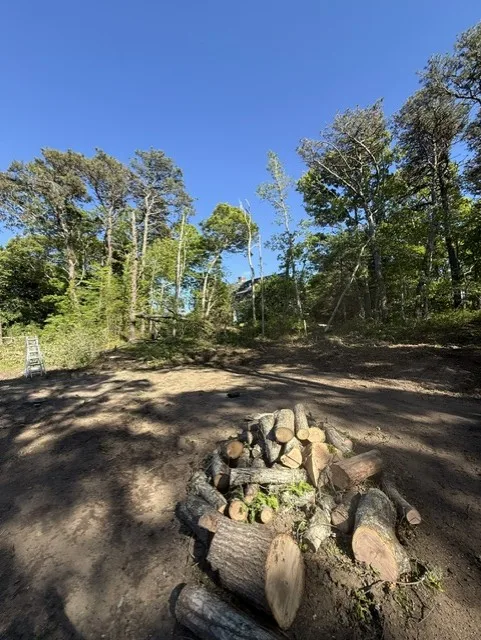
Brush removal and land clearing take out undergrowth, saplings, vines and unwanted trees to open up usable ground. Cape Cod owners use it to reclaim overgrown yards, clear a building or septic site, or push thick woods back from the house.
The work ranges from a half-day of cutting back a tangled property edge to clearing a wooded lot for a foundation. Small jobs involve cutting brush, briars and saplings at ground level and chipping everything. Larger jobs add tree felling, log removal and stump grinding or stump removal, depending on what the land will be used for. Selective clearing is common too. That means keeping the good oaks and cedars, removing the dead pines and the understory, and leaving a yard that looks like woodland instead of a jungle.
A clearing job is planned from the edges inward. Property lines and any no-cut zones are confirmed first, then trees you want to keep are flagged so there is no confusion once saws are running. The crew fells and processes trees in an order that keeps a clear path to the chipper and truck. Stumps are cut low for later grinding. Material is chipped or hauled, not left in piles. Modern equipment does the heavy work, with hand cutting close to buildings, walls and fences. Safety drives the sequence.
Much of the Cape is pitch pine and scrub oak woodland, which grows into a dense, dry thicket when left alone. Add catbrier, bittersweet, poison ivy and bayberry, and a back lot can become impassable in a few years. Thinning that growth near a house also removes fuel, which matters in pine barrens country. Limits apply close to wetlands, kettle ponds, coastal banks and dunes, where the Conservation Commission may need to sign off before anything is cut. Sandy soil erodes once bared, so slopes deserve some thought.
Expect a site visit and a written estimate that says where clearing starts and stops. Before the crew arrives, mark the boundary if you know it and tie ribbon on anything to be saved. Clearing is loud and looks rough partway through. By the end, brush is gone, logs are removed or stacked, and the ground is raked to a usable finish. Low growth will try to return from roots, so plan on mowing or a follow-up cut the next season if you want it kept open.
How it works
From first call to clean yard
01
Walk the land
Meet on site or send a plot plan. Clearing limits, keeper trees and any wetland or setback concerns are discussed before a price is written.
02
Flag and confirm
Boundaries and trees to save are ribboned. If town approval is needed for part of the work, that gets sorted out before cutting begins.
03
Cut and chip
Brush comes out first, then trees are felled and processed. Chips and logs are moved off as the crew works across the lot.
04
Finish grade cleanup
Stumps are cut low or ground, debris is raked out, and you walk the cleared area with the crew to confirm it matches the plan.
Pricing
What affects the price
Area to clear
A strip along a property line is priced very differently from a full house lot. The estimate is based on the measured area and where the limits are drawn.
Density and tree size
Light brush and saplings go quickly. A stand of mature pitch pine and oak with thick undergrowth means felling, limbing and far more material to move.
Stump handling
Cutting stumps flush is the least work. Grinding them suits lawns and yards. A building site may need stumps pulled entirely, which is a larger operation.
Disposal volume
Chips and logs have to go somewhere. Spreading chips on site or keeping firewood lowers trucking. Hauling everything off a large lot adds loads and time.
Terrain and access
Flat ground with a driveway alongside is straightforward. Steep banks, soft sand, wet spots or a long carry from the road slow equipment and add hand labor.
Reviews
What customers say
We had 8 trees we wanted taken down. From the initial quote visit all the way to the final tree coming down the process was made simple and pleasant. The crew was courteous, caring about our property, and very professional.
The crew arrived promptly at 8 am. Tree and large limb on another tree were removed, yard was cleaned as if the removal never happened, and they were gone by 10 am. Great job.
Isaiah is a young professional who’s already proven himself. He was quick to respond, worked hard, and left everything clean. I’d gladly hire him again.
Questions
Brush Removal & Land Clearing FAQ
It depends on the location and the town. Clearing within the buffer of a wetland, pond, coastal bank or dune generally needs Conservation Commission review. Some towns also regulate clearing tied to new construction, and historic districts or scenic roads can add steps. Call your town's conservation and building departments before work starts. Ordinary yard brush cutting usually needs nothing.
There is no flat rate that holds up, because lots differ so much. Size, how thick the growth is, the number and size of trees, what happens to stumps, and how far material has to be hauled all drive the figure. A free site visit produces a written estimate with the clearing limits shown.
Yes, and on many Cape lots that is the better result. Healthy oaks, cedars and beech are flagged and kept. Dead or crowded pines, saplings, vines and undergrowth come out. You end up with open, shaded ground and more privacy than a bare lot. Decide which trees stay before the crew begins cutting.
Vines and briars are cut and removed with everything else. Cutting does not kill poison ivy or catbrier roots, so some regrowth is normal. Regular mowing of the cleared area keeps it down. Let the crew know where poison ivy is heavy so they can handle and chip that material with care.
It helps. Pitch pine and scrub oak woods are naturally fire-prone, and dry brush, dead lower limbs and pine litter close to a building give a fire a path. Thinning undergrowth, removing dead trees and raising low branches near the house reduces fuel. It lowers risk without eliminating it, and it needs upkeep every few years.
Related services
Ready for a free estimate?
Call or send a photo of the tree. You get the price before any work starts.