
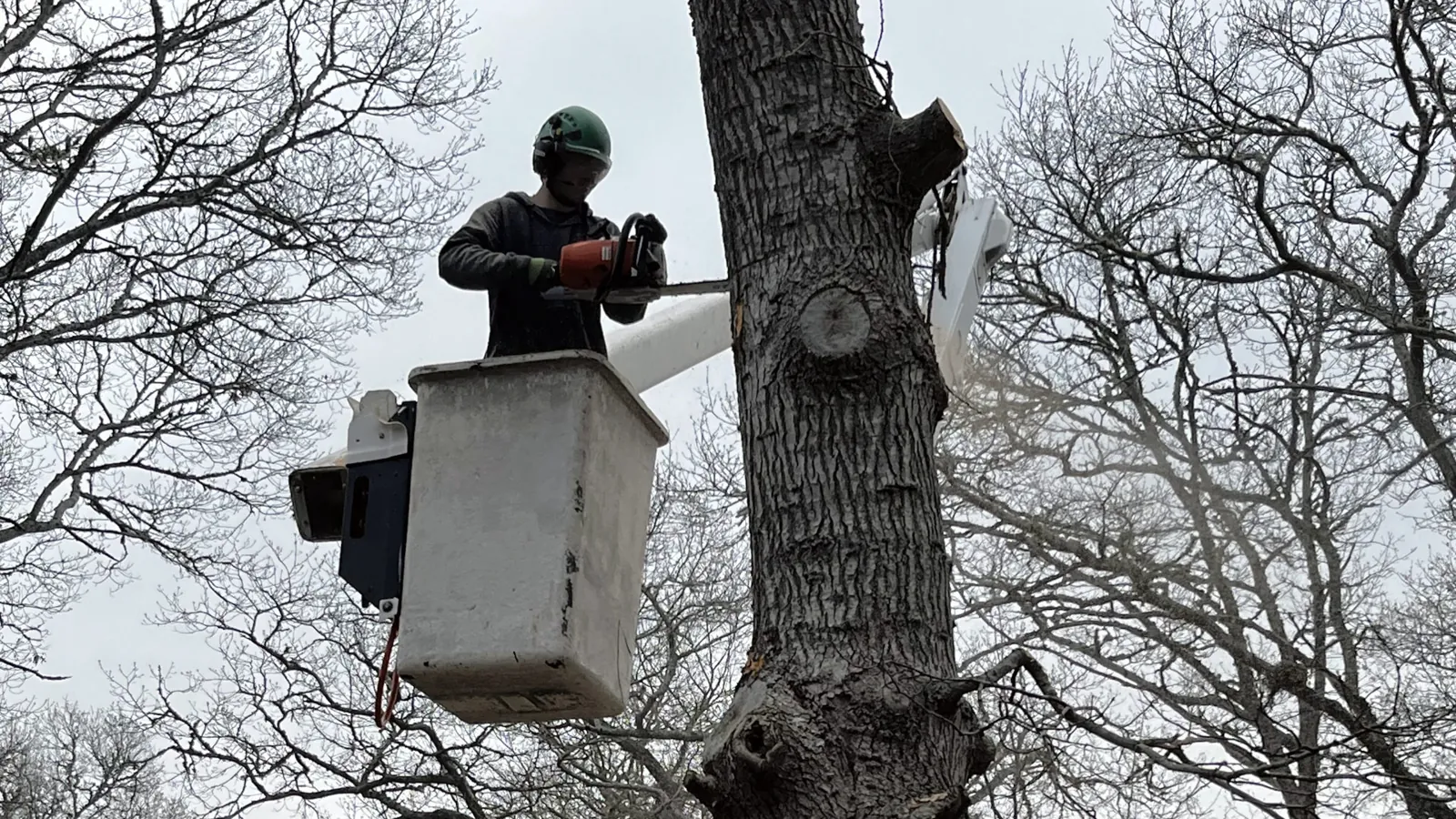
Tree services
Tree trimming and pruning is the selective removal of dead, weak, rubbing or overgrown branches to keep a tree safe and healthy. It suits Cape Cod owners who want to keep their trees but need clearance, light or storm resistance.
Pruning covers several kinds of cuts, each with a purpose. Deadwood removal takes out branches that will fall sooner or later. Crown thinning lets wind pass through instead of pushing against a solid canopy. Raising lifts low limbs off driveways, walks and lawns. Reduction shortens long, heavy branches that hang over a roof. Clearance pruning opens space around chimneys, gutters and service wires to the house. Not every tree needs all of these. A good plan picks the cuts that solve your problem and leaves the rest alone.
Before any cutting, the crew looks at the whole tree, not only the branch that bothers you. They check for cracks, old storm wounds, weak forks and signs of pests. Cuts are made just outside the branch collar so the tree can seal the wound itself. Large limbs come off in stages to avoid tearing bark. Trees are not topped, because topping creates weak regrowth and decay. As a rule, only a modest share of live growth is removed in one season. Safety gear and modern equipment are standard.
Wind shapes trees on the Cape. Salt spray burns the seaward side of oaks and cedars, and constant wind produces lopsided crowns that carry more weight on one side. Thinning and balancing those crowns before hurricane season lowers the odds of a limb failure. Oaks recovering from spongy moth or winter moth often carry dead tips that should come out. Beech with beech leaf disease need a careful eye. Pitch pines hold dead lower limbs for years, which are worth clearing near a house.
After a free estimate, you will know which trees are being worked on and what each will look like afterward. On pruning day, expect a crew in the trees or working from the ground, a chipper running, and limbs being lowered away from plantings. A properly pruned tree should look natural, not stripped. All brush is chipped and removed. Hardwoods may push new growth the next spring. Most mature trees benefit from another look every few years, sooner if they overhang a roof.
How it works
From first call to clean yard
01
Walk the property
You show the crew lead what concerns you. They look at each tree and suggest which cuts will help and which are not worth doing.
02
Written estimate
The estimate lists the trees and the pruning planned for each one. It costs nothing, and there is no pressure to book.
03
Pruning day
Climbers and ground crew work through the trees in order. Limbs over structures are lowered on ropes. Brush is chipped as it comes down.
04
Cleanup and review
The crew rakes up, clears walks and driveways, and reviews the finished work with you. Seasonal owners can get photos by email instead.
Pricing
What affects the price
Number of trees
One oak over the garage is a short visit. A full property with a dozen mature trees is a day or more. Grouping trees into one visit usually costs less per tree.
Height and spread
Bigger crowns mean more climbing, more cuts and more brush to chip. A broad old oak takes far longer to prune well than a young maple on the lawn.
Type of pruning
Light deadwood removal goes quickly. Reducing heavy limbs over a roof, or balancing a wind-shaped crown, takes more planning, more rigging and more time in the tree.
Obstacles below
Branches over a house, deck, pool or garden have to be roped down piece by piece. Limbs over open lawn can simply be dropped and dragged to the chipper.
Site access
If the chipper can park near the work, cleanup is fast. Long drags through a fenced backyard or down a narrow cottage path add labor to the job.
Reviews
What customers say
We had 8 trees we wanted taken down. From the initial quote visit all the way to the final tree coming down the process was made simple and pleasant. The crew was courteous, caring about our property, and very professional.
The crew arrived promptly at 8 am. Tree and large limb on another tree were removed, yard was cleaned as if the removal never happened, and they were gone by 10 am. Great job.
Isaiah is a young professional who’s already proven himself. He was quick to respond, worked hard, and left everything clean. I’d gladly hire him again.
Questions
Trimming & Pruning FAQ
Late fall through winter is ideal for most hardwoods. The tree is dormant, the branch structure is easy to see and pests are less active. Dead, broken or hazardous limbs can be removed in any season. Light clearance pruning is also fine in summer. Many owners schedule storm-prep pruning before late summer, when tropical systems become more likely.
Less than most people think. A common guideline is to remove no more than about a quarter of the live crown in one season, and often much less on older or stressed trees. Taking too much forces weak, fast regrowth and can starve the tree. Dead wood does not count toward that limit and can all come out.
Often yes, but check first. Trees near a pond, marsh, coastal bank or dune may fall under Conservation Commission jurisdiction, and view pruning there can need approval. Where it is allowed, selective thinning and limb removal usually open a view while keeping the tree healthy. Topping trees for a view damages them and is not recommended.
No. Topping cuts main stems back to stubs. The tree responds with a thicket of weakly attached shoots, and the large wounds invite decay. Within a few years it is often more hazardous than before. Crown reduction, done with proper cuts back to side branches, lowers height and weight without that damage.
It is one of the more useful things you can do. Removing dead wood, thinning dense crowns and shortening long limbs over the house gives wind less to grab. It does not make a tree storm-proof, especially in sandy soil. It does reduce the number of branches likely to come down in a nor'easter or tropical storm.
Related services
Ready for a free estimate?
Call or send a photo of the tree. You get the price before any work starts.